I only got into rugby coaching when my eldest was in the U11s and his head coach appealed for help. Standing on the touchline and watching, I figured “ah – he means me…”. Initially, I just put out cones, held tackle bags and blew a whistle (lots!) [Ed: the Karl is strong in this one.]
A few years on, I’m part of a group of four coaching 30-40 U14s that combines the two age groups of U13 and U14.
Kerry is very much GAA – especially Gaelic football – country. But rugby has a history here, and actually pre-dates the GAA. The 1880s to 1920s were a time of huge turbulence in Ireland, and part of that led to the abandonment of rugby as a ‘foreign sport’ in favour of the new ‘Irish’ game (soccer, cricket and hockey were also regarded as ‘foreign’). Historically, a football game called ‘caíd’ was played in Kerry, but there’s very little evidence of how it was played: we can surmise it might be closer to the Shrove Tuesday games played in England than any modern code of football. There are theories that it might have been akin to Aussie Rules, as that seemed to spring up on the gold fields in the 1850s, where many Irish had headed off to make their fortune.
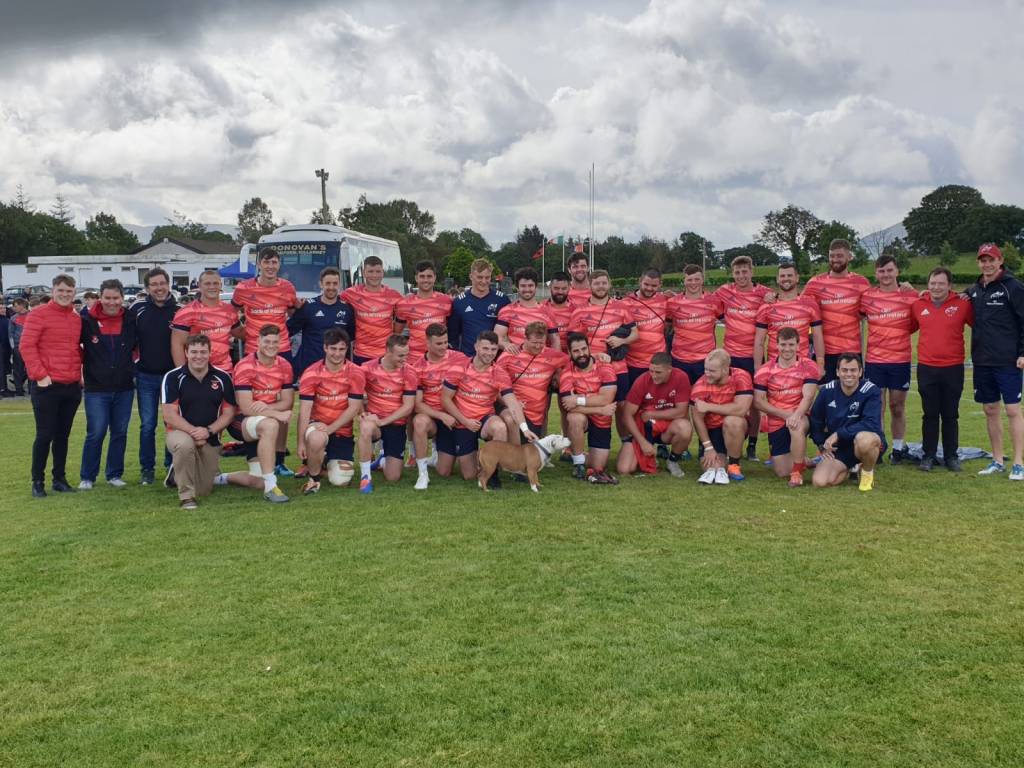
Rugby in Killarney goes back to the 1880s, and the club notes an official founding of 1929 – but it’s been re-founded on at least 3 other occasions: 1937, 1953 and 1983. With our own field and two decent pitches (and a third … well, it needs work…), we’re in a position to grow rather than just survive. In September 2019, we even hosted a Munster pre-season training session.
As a club at U14 level, which is the first competitive level (full-sized pitch, fifteen a side – hopefully), we compete in what is termed West Munster – essentially this is the other clubs in Kerry plus one other. We only get to play clubs from Cork and Limerick in friendlies or challenges slotted in between regular fixtures. In an ideal world we’d break out of this, as we end up playing the same local rivals three or four times in a season. In September, it’s all healthy competition; by March they hate each other’s guts. Doesn’t help that same group of lads also run into each in schools and club football and soccer over the same period.
Our season breaks into two parts. Before Christmas, there is a local league decided by a premiership-style knockout format (1 v 4 and 2 v 3) to eliminate the vagaries of no home-and-away. After Christmas, the West Munster teams split into an upper and lower section, with a home and away format. We took this opportunity to split our squad in two. The competition rules initially were that you could name an extended panel, and play all the subs in a non-competitive ‘3rd half’.
However, several clubs were struggling to make fifteen, so the rules reverted to two halves and a maximum squad of 23. That left us with ten not getting any game at all, plus subs only playing five to ten minutes at the end. The three-thirds is well-intentioned, but it’s really aimed at clubs with maybe 23-25 players to ensure everyone plays. It’s well-nigh impossible to play 15+ subs: you end up trying to replace the whole team without giving them adequate time to ‘gel’ as a unit.
We bit the bullet, knowing that we’d be stretched for numbers at times, but also knowing that we had the option to start with as few as twelve if numbers got sticky. The real restriction was having to separate the two squads: that meant a few hard decisions.
We wanted a ‘Black’ team to have a chance at winning their competition, but we didn’t want a ‘Red’ team comprised only of inexperienced – and in many cases smaller – 12-13 year olds who’d have to face up to teams made up mainly from the age grade above. A couple of the older lads were asked to step down to the junior squad to help provide some experience and sheer size.
The smaller size of clubs down here means that we don’t have a dedicated U13 competition, which means our younger players can be faced with bigger and more experienced U14s at a time when they’re really just learning to play the ‘adult’ game. It was a risk, but the alternative was standing on the sideline getting cold or not playing at all.
In our first Black game, we lost away to what was regarded as the best U14 in our region, but the seeds were there. 38-14 was final score, but we were beginning to see our strengths (and weaknesses) and to start to recognise the opposition’s.
Strengths: good scrum (if not a lot of use at U14 as limited pushing is allowed), strong, fast ball-carriers, good kicking game.
Weaknesses: looking for contact, over-carrying, weak support running.
Red started off badly, run ragged by a combined club with a couple of gifted individuals. Their second match, a return fixture, was much the same until we persuaded the opposition to ‘retire’ their No.8. Thereafter it was much more even, and you could see the inexperienced players beginning to develop their teamwork and understanding: where should I be? who’s my man? Attack the ruck or stay out?
Their remaining two games were close – a one-score difference in each game – and unlucky not to win one or both of them. But overall, despite the disappointment of losing, they all got to play an hour’s rugby in four games, and there’s a development in actually playing that you can’t get from all the training sessions in the world.
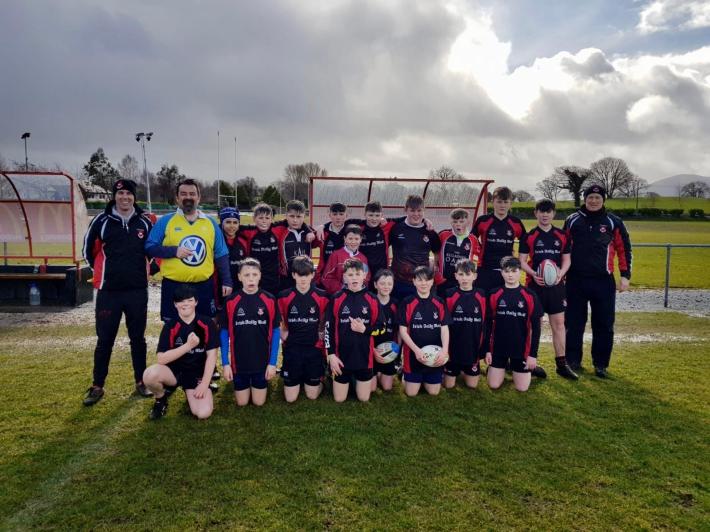
Meanwhile, in Black world we had 2 good wins: 26-17 and 28-7, the first win from 12-0 down and for much of the game playing 13 v 15 when the opposition conveniently ‘forgot’ that all clubs had agreed to match numbers. There’s a bit of thrill when you comprehensively defeat a team whose mentors are trying to pull a fast one. The second win was against a club we’d lost to twice earlier in the first half of the season by 5 and 3 points – basically losing both games from a place where we should have won.
In both wins, there was a pleasing degree of – dare I say it – ‘T-CUP’. Carrying the ball against the wind, and in the second half kicking long and chasing like demons. Then came a defeat: 12-5 and a wake-up call that we’re weren’t going to bulldoze everyone. Our final – not that we knew that at the time – game was a return versus the Tralee team who’d handed out two thorough beatings to us before. Tables were turned this time as we defeated them 36-5.
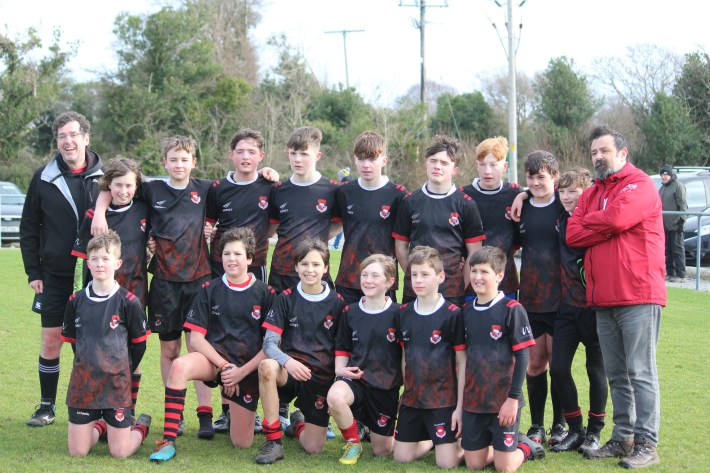
So it looks like we went out on a high. The lads themselves were recognising their strengths and trying not to play to those of the opposition. We helped them by moving our usual 8 (quick, strong but not excessively big) into 10 and letting him get into the face of the opposition 10 … who didn’t get the armchair ride he was used to.
For me, the main takeaway or ‘learning’ (as my international work colleagues might say) is that we need to get lads playing. We can train them with drills to develop the skills, but they need to play, and play together, to build up their knowledge. Five, ten or fifteen minutes as a sub doesn’t help that development. It’s certainly a bugbear of mine to see a visiting club arrive with 23 or 24 players, knowing that numbers 16-23 will get a few token minutes when the game is already won or lost. We’d be better off to play 12 v 12, and adjust the rules slightly.
I get irritated by coaches for whom winning is obviously the priority. Winning is great, but the long-term view is to have as many as possible playing – and enjoying playing – our game. Hopefully, some of them will be standing on a touchline in 30 years’ time, having replaced me….
Courtesy of Triskaidekaphobia.
 Ovally Balls
i was young and foolish…………………
LikeLike
My Dad saw The Who around 1970ish. Thought they were a bit OTT.
A bloke from Oldham I know went to the famous 1970 Isle of Wight festival, seeing Hendrix etc. Thought it was boring, apart from Jethro Tull. They were great apparently.
LikeLike
Slade, now you’re just showing off. Did you ever see Slade, by the way?
LikeLike
Slade was showing off from his first post on the topic. Went green, I did.
LikeLike
DeeBee – good dog no!
LikeLike
As a teenager, Manchester was good for rock bands etc and then SheFF Uni seemed to have links with Island records so we got pre-tour performances as well as all that was going round at the time – it was better than revising!
LikeLike
Apols for no new ATL yet, btw. Been stupidly busy at work, which is not conducive to the late-night alcohol-fuelled writing I was hoping to do.
LikeLike
On my Spotify mix today I had the first Byrds album (Mr Tambourine Man, 1965), then later I had the first Depeche Mode album (Speak and Spell, 1981). I don’t know if it was just the production or the instruments used in the early 80s, but the Depeche Mode one now sounds more old-fashioned than the Byrds one! Of the few Depeche Mode albums I’ve heard, I’ve tended to prefer the ones where the sound got a bit darker and harder.
LikeLike
……wasn’t the Byrds 8 Miles High written/conceived on a plane flying in to Cardiff?
LikeLike
Depeche Mode are still really popular in France……………………
LikeLike
That first Byrds album had this on it. Even Tom Petty couldn’t improve on it when he did a cover version.
LikeLiked by 1 person
Post imminent.
LikeLike